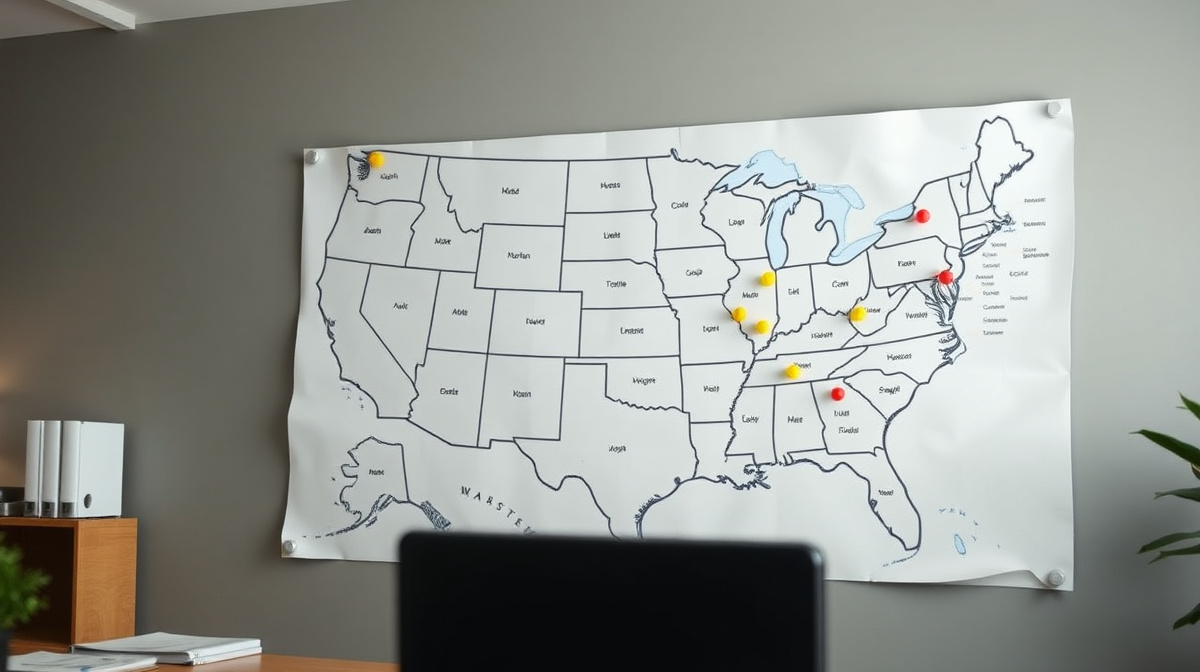
States That Require a Specific Insulation Contractor License
Most guides to contractor licensing talk about "general contractor licenses" as if that's the whole story. For spray foam insulation installers, it usually isn't. A meaningful number of states carve insulation out as its own licensing category — separate from a general contractor license, with its own classification code, its own scope description, and sometimes its own exam. If your state is one of these, holding a general contractor license alone may not be enough.
Based on our state-by-state research, here are the states where we identified a genuinely distinct, named insulation classification:
Arizona
The Arizona Registrar of Contractors issues C-40 (commercial), R-40 (residential), and CR-40 (dual) Insulation classifications. Arizona requires this licensing for insulation work regardless of project size — there's no small-job exemption. See the Arizona page
California
The CSLB's C-2 (Insulation and Acoustical Contractor) classification is the relevant license — a general "B" license does not automatically cover insulation work. See the California page
Louisiana
The Louisiana State Licensing Board for Contractors lists "Insulation" as a specific specialty classification, required once a project crosses $50,000 (commercial/new residential) or $7,500 (home improvement). See the Louisiana page
Michigan
Insulation is a named trade code ("G") under Michigan's Residential Maintenance & Alteration Contractor license, complete with its own 100-question trade exam. See the Michigan page
Mississippi
The Mississippi State Board of Contractors splits insulation into two classifications: general wall/attic/exterior insulation, and mechanical pipe/duct insulation (which requires a trade exam). See the Mississippi page
Nevada
Nevada's C-15c classification specifically references urethane among the materials it covers for building insulation. See the Nevada page
New Mexico
New Mexico's GS-1 ("Acoustical Insulation and Insulation") classification explicitly names urethane foam among the materials it covers. See the New Mexico page
North Carolina
An "S(Insulation)" specialty designation can be added to a Building or Residential general contractor license once a project reaches $30,000. See the North Carolina page
Utah
Utah's S250 "Insulation Contractor" classification requires a 25-hour prelicense education course plus an exam — one of the more education-heavy paths on this list. See the Utah page
Virginia
DPOR's Board for Contractors recognizes an "Insulation and Weather Stripping" specialty classification that can be added to any license class. See the Virginia page
West Virginia
Listed as Specialty code 026, classified as an "untested specialty" — meaning applicants take only the Business & Law exam, no trade-specific exam. See the West Virginia page
Alaska
Alaska's "Acoustical and Insulation Contractor" trade designation is registered separately from general contracting, and requires its own $10,000 surety bond. See the Alaska page
Massachusetts and Wisconsin (Worth Watching)
Two more states have mechanisms close enough to a specific license that they're worth flagging: Massachusetts's Construction Supervisor License offers an "Insulation" specialty restriction category, and Wisconsin's Dwelling Contractor Qualifier certification explicitly lists insulation among its defined work categories for anyone pulling residential permits.
Why This Matters
If you're licensed as a general contractor in a state that has one of these dedicated insulation classifications, that general license may not automatically authorize you to bid or perform SPF installation work — you may need the specific classification on top of it. This is one of the most common gaps we see: contractors correctly get a general contractor license and assume it covers everything, when their state actually carved insulation out separately.
The reverse is also true and just as important: most states do NOT have a distinct insulation classification. If your state isn't on this list, don't assume one exists — check your state's page for what actually applies.
Requirements change. Classification codes, thresholds, and exam requirements get updated by state legislatures and licensing boards. Always confirm current details directly with the relevant board before applying.
More Guides

Expanding Your SPF Business to a New State: A Licensing Checklist
A practical checklist for spray foam contractors expanding into a new state, from confirming the license model to budgeting for bonding and insurance.
General Contractor License vs. Insulation License: What SPF Installers Need to Know
How to tell whether your state needs a general contractor license, a specific insulation classification, both, or neither for spray foam work.
SPFA Certification Explained: What It Is and What It Isn't
What the SPFA Professional Certification Program actually covers, its four levels, and why it isn't a substitute for state contractor licensing.
Not Sure What Your State Requires?
Tell us your state and where you are in the process — we'll point you to the right licensing board, classification, and next step. It's free, and there's no obligation.