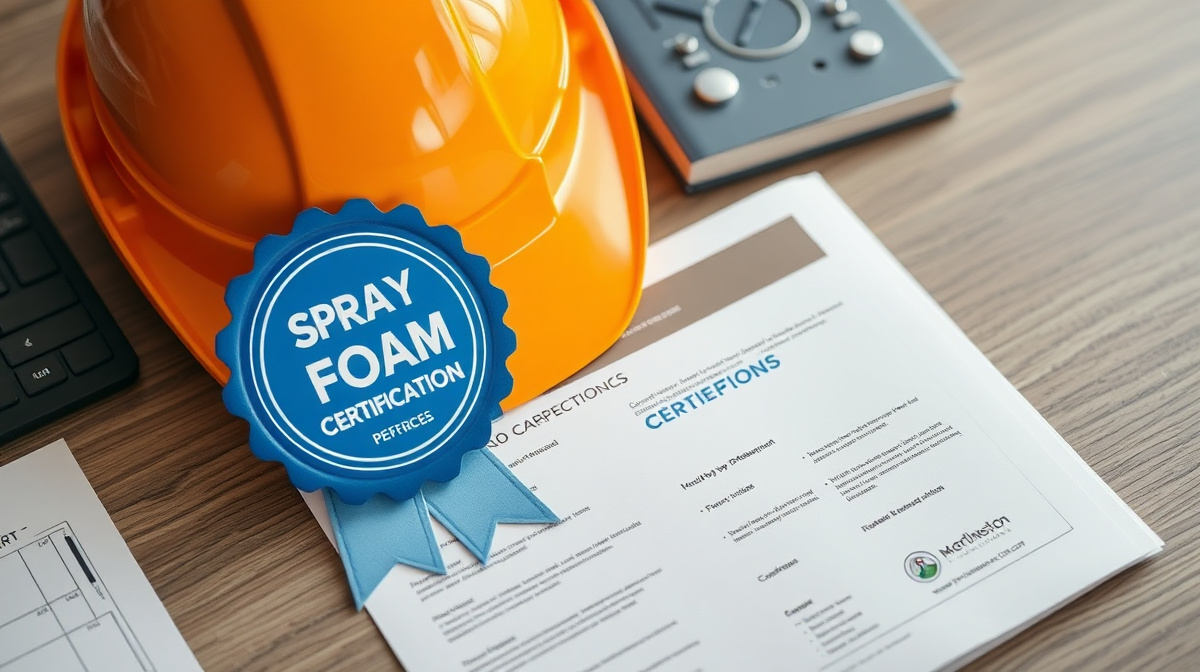
SPFA Certification Explained: What It Is and What It Isn't
If you've spent any time researching how to legally install spray polyurethane foam (SPF), you've run into two very different systems that get talked about as if they're the same thing: state contractor licensing, and SPFA certification. They are not the same thing, and mixing them up can cost you time — or worse, get you working without the credential you actually needed.
What SPFA Is
The Spray Polyurethane Foam Alliance (SPFA) is the SPF industry's trade association. It runs the Professional Certification Program (PCP), a voluntary, individual-level credentialing system built to industry standards (SPFA references ISO 17024 as the framework its program adheres to).
The Four Certification Levels
SPFA's PCP has two separate tracks — Insulation and Roofing — each with the same four-level structure:
Insulation track:
- Assistant — no spraying experience required; written exam only.
- Installer — requires roughly 100,000 board-feet of spraying experience; a two-part exam that includes the Assistant-level material.
- Master Installer — requires roughly 500,000 board-feet of spraying experience; a cumulative exam.
- Project Manager — requires having managed a minimum of 500,000 board-feet of spray foam projects.
Roofing track: the same four levels (Assistant, Installer, Master Installer, Project Manager), measured in square footage of roofing work instead of board-feet.
You don't have to start at Assistant. SPFA's structure lets you enter at whatever level matches your actual experience — the exam at each level simply includes the material from the level below it.
What SPFA Certification Is NOT
This is the part that trips people up: SPFA certification is not a legal requirement to hold a state contractor license in any state we researched. No state licensing board we identified across all 50 states makes SPFA certification a condition of issuing or renewing a contractor license, an insulation specialty classification, or a business registration. It's an industry-recognized credential, not a regulatory one.
That doesn't mean it's irrelevant. A few places where SPFA certification does carry real weight:
- Manufacturer requirements. Several SPF material manufacturers require installers to complete their own certification or SPFA-aligned training to purchase certain products or to keep a warranty valid. This is a business/contractual relationship with the manufacturer, not a government requirement.
- Federal specifications. SPFA's Professional Certification Program has been referenced in federal Unified Facilities Guide Specifications (UFGS), which some government construction projects use to define acceptable installer qualifications. That makes it practically important for contractors who want to bid certain federal work, even though it's still not a "license" in the legal sense.
- Company accreditation. Separate from individual certification, SPFA also runs company-level accreditation and membership programs — a different credential from the individual PCP levels above.
So What Do You Actually Need?
Your state's contractor licensing requirement — whatever that turns out to be — is the legal floor. SPFA certification sits on top of that as a professional credential that can help you win work, satisfy manufacturer requirements, and demonstrate competence to customers, but it does not replace whatever your state or local jurisdiction requires to legally operate.
The practical order of operations for most installers: figure out your state's licensing requirement first (start with our 50-state directory), get that squared away, and treat SPFA certification as a professional development track alongside it — not instead of it.
A note on accuracy: licensing and certification requirements change. Always verify current SPFA program details directly with SPFA, and current licensing requirements directly with your state's contractor licensing board, before relying on any of this to make a business decision.
More Guides

Expanding Your SPF Business to a New State: A Licensing Checklist
A practical checklist for spray foam contractors expanding into a new state, from confirming the license model to budgeting for bonding and insurance.
General Contractor License vs. Insulation License: What SPF Installers Need to Know
How to tell whether your state needs a general contractor license, a specific insulation classification, both, or neither for spray foam work.
States That Require a Specific Insulation Contractor License
A rundown of the states with a genuinely distinct insulation contractor license or specialty classification, separate from general contracting.
Not Sure What Your State Requires?
Tell us your state and where you are in the process — we'll point you to the right licensing board, classification, and next step. It's free, and there's no obligation.